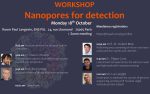
« Nanopore for detection » workshop (Oct. 18th – 8:45 am : 1 pm)

program_nanopore workshop
The Workshop « Nanopores for detection » organized by IMAP (Mathilde Lepoitevin) and LAMBE (Juan Pelta) will take place on October 18 from 8:45 am at ENS, Department of Chemistry, 24 Rue Lhomond, 75005 Paris, salle Paul Langevin (limited to 40 persons) and in hybrid (zoom link after registration).
Mandatory registration: https://tinyurl.com/43zc787s
We will review European research that explores recent developments for real-time detection of target molecules at the single molecule scale. We aim to address societal challenges such as personalized medicine through ultra-fast analysis of biomolecules using nanopore technology. The speakers will be Robert Blick (University of Hamburg), Mauro Chinappi (Università Tor Vergata Roma) and Fred Antson (University of York), and also we will get updates from the industrial side with Filippo Cona (Elements), and Luc Lenglet (Dreampore).

Mathilde Lepoitevin is inviting you to a scheduled Zoom meeting.
Topic: Nanopore workshop
Time: Oct 18, 2021 08:45 AM Paris
Join Zoom Meeting
https://us02web.zoom.us/j/85190662105?pwd=RmZkZU43dWMvQUxmd01HSXZmaWtRUT09
Meeting ID: 851 9066 2105
Passcode: nanopore


MOF4AIR first newsletter!!

The first #MOF4AIR Newsletter is out! Download the newsletter here (https://mof4air.eu/newsletter/) to find out information on the WP progress, coming events and next steps Coche en gras
Don’t forget to subscribe to the Newsletter to make sure you don’t miss any updates!

New IMAP article on Metal-Organic Frameworks: from ambient green synthesis to applications

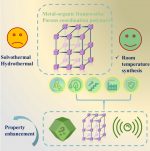
Congrats to Shan Dai, Antoine Tissot and Christian Serre for their paper « Metal-Organic Frameworks: from ambient green synthesis to applications » in Bulletin of the Chemical Society of Japan .

Abstract:
Studies of the room temperature synthesis of Metal-Organic Frameworks (MOFs) are still scarce and mainly focused on divalent metals based MOFs. The development of room temperature synthesis of more chemically robust MOFs is still challenging and therefore lacks of exploration. Here, we review the development of ambient conditions synthesis of MOFs, from the properties of the sole MOF to their related composites. Low temperature green synthesis can not only meet the standards of sustainable chemistry, but also help to achieve a series of property enhancements, including their applications in catalysis, biomedicine, and sensing. Finally, perspectives associated to the synthesis strategies and applications of room temperature methods are discussed.
More info here: https://doi.org/10.1246/bcsj.20210276 

Latest IMAP article on « Monodispersed MOF-808 Nanocrystals…

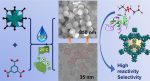
Congrats to Shan Dai, Antoine Tissot and Christian Serre for their paper « Monodispersed MOF-808 Nanocrystals Synthesized via a Scalable Room-Temperature Approach for Efficient Heterogeneous Peptide Bond Hydrolysis » in Chem. Matter.
Article here: doi.org/10.1021/acs.chemmater.1c02174

Abstract
Zr(IV)-based metal–organic frameworks (MOFs) such as the Zr(IV) trimesate MOF-808 are promising materials for catalytic applications. In this work, we report an aqueous solution-based room-temperature strategy to produce well-defined monodispersed MOF-808 nanocrystals down to 35 nm with a high space-time yield, up to 2516 kg/m3/day, and excellent crystallinity and porosity. The resulting nanocrystals show remarkable colloidal dispersion during 1 day in a wide range of nanoparticle concentrations. As a result, 35 nm MOF-808 colloidal-level nanocrystals exhibit the highest rate of selective peptide bond and protein hydrolysis among the reported Zr(IV)-based MOFs. This result may open new opportunities for highly efficient peptide or protein hydrolysis using scalable nanocatalysts.

IMAP 2021 – Webinar series: Prof. Christof Wöll (July 13th at 2pm)

IMAP 2021 Webinar series
13th of July 2021 at 2pm
Online on Zoom
https://us02web.zoom.us/j/84719725729?pwd=UUl2bHRDcWJaQnpLNzRsS3JyeDlHQT09
Meeting ID: 8847 1972 5729
Secret code: jwHG3k

Assembling Designer Solids from Molecular Building Blocks: Principles, Prospects, and Problems

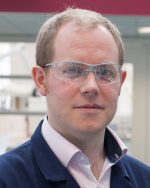
Prof. Christof Wöll
Institute of Functional Interfaces (IFG), Karlsruhe Institute of Technology, North Campus, 76021 Karlsruhe, FRG

Realizing molecular “Designer Solids” by programmed assembly of building units taken form libraries is a very appealing objective. Recently, metal-organic frameworks (MOFs) have attracted a huge interest in this context. Here, we will focus on MOF-based electrochemical, photoelectron-chemical, photovoltaic, and sensor devices. Internal interfaces in MOF heterostructures are also of interest with regard to photon-upconversion and the fabrication of diodes.

Since the fabrication of reliable and reproducible contacts to MOF-materials represent a major challenge, we have developed a layer-by-layer (lbl) deposition method to produce well-defined, highly oriented and monolithic MOF thin films on appropriately functionalized substrates. The resulting films are referred to as SURMOFs [1,2] and have very appealing properties in particular with regard to optical applications [3]. The fabrication of hetero-multilayers (see Fig. 1) is rather straightforward with this lbl method. In this talk, we will describe the principles of SURMOF fabrication as well as the results of systematic investigations of electrical and photophysical properties exhibited by empty MOFs and after loading their pores with functional guests. We will close with discussing further applications [4] realized by loading MOFs with nanoparticles or quantum dots.
References:
[1]J. Liu, Ch. Wöll, Chem. Soc. Rev. 46, 5730-5770 (2017)
[2]L. Heinke, Ch. Wöll, Adv. Mater. 31 (26), 1970184 (2019)
[3]R. Haldar, L. Heinke, Ch. Wöll, Adv.Mater. 32, 1905, (2020)
[4]A. Chandresh, X. Liu, Ch. Wöll, L. Heinke, Adv. Sci.,8, 2001884 (2021)

IMAP 2021 – Webinar series: Prof. Ross Forgan (June 29th at 2pm)

IMAP 2021 Webinar series
29th of June 2021 at 2pm

Online on Zoom
https://us02web.zoom.us/j/84312479733?pwd=ZUhSUVh1WFBnQVhRQnJTZmIvVnVzUT09
Meeting ID: 843 1247 9733
Secret code: K3nwq9

Tuning Properties and Functionality in the Modulated Self-Assembly of Metal-Organic Frameworks

Prof. Ross S. Forgan
WestCHEM School of Chemistry, University of Glasgow

Metal-organic frameworks (MOFs) are network materials comprised of organic ligands connected by metal ion clusters into multidimensional structures that often have permanent porosity. Their chemically addressable structures, combined with their ability to store large quantities of small molecules within their pores, have led to applications in gas storage, heterogeneous catalysis, sensing, and drug delivery, amongst others. Coordination modulation, the addition of monomeric modulators to synthetic mixtures, can tune particle size from nanometres to centimetres, through capping of crystallites (decreasing size) or coordinative competition with ligands (increasing size).
The talk will cover the development of our own modulation techniques for a range of trivalent and tetravalent MOFs, describing the versatility of modulation in controlling physical properties such as interpenetration, defectivity, and porosity.1 Our techniques provide access to high quality single crystals of many different MOFs, allowing the subsequent characterisation of their mechanical properties,2 flexibility upon guest uptake,3 single-crystal to single-crystal postsynthetic modification,4 and development of fluorescent sensors.5 Additionally, we will show that protocols can be tuned to downsize materials, producing nanoparticles with fine control of surface chemistry, allowing the assembly of pH-responsive6 and organelle targeted7 drug delivery devices.

1Marshall, R. J. et al., J. Mater. Chem. A 2018, 6, 1181–1187.
2Hobday, C. L. et al., Angew. Chem. Int. Ed. 2016 55, 2401–2405.
3Marshall, R. J.; McGuire, J.; Wilson, C.; Forgan, R. S. Supramol. Chem. 2018, 30, 124–133.
4Marshall, R. J.; Griffin, S. L.; Wilson, C; Forgan, R. S. J. Am. Chem. Soc. 2015, 137, 9527–9530.
5Marshall, R. J. et al., J. Am. Chem. Soc. 2017, 139, 6253–6260; Sussardi, A. et al., Angew. Chem. Int. Ed. 2020, 59, 8118–8122
6Abánades Lázaro, I. et al., Chem 2017, 2, 561–578.
7Haddad, S. et al., J. Am. Chem. Soc. 2020, 142, 6661–6674.

IMAP 2021 – Webinar series: Prof. George Shimizu (June 3rd at 4pm)

IMAP 2021 Webinar series
3rd of June 2021 at 4pm

Taking a New Solid CO2 Sorbent from Discovery to Commercialization

Prof. George Shimizu
Department of Chemistry, University of Calgary, Canada

Metal-organic frameworks (MOFs) are transcending from fundamental to applied research, but their use in a large-scale process has not been realized. For carbon capture, solid sorbents face a challenge of merging efficient capture with economical regeneration in a durable, scalable material. This presentation will discuss the molecular features that impact CO2 capture in porous solids and then present a case study of a MOF, Calgary Framework CALF20 that has progressed to industrial use for CO2 capture. CALF20 satisfies all key capture criteria while having a low regeneration penalty, durability and demonstrated scalability.

Online (contact antoine.tissot@ens.psl.eu for registration)

New review: Recent Progresses in Metal–Organic Frameworks Based Core–shell Composites

Congrats to Shan Dai, Antoine Tissot and Christian Serre for their review paper « Recent Progresses in Metal–Organic Frameworks Based Core–shell Composites » in the journal Advanced Energy Materials
Article here: doi/10.1002/aenm.202100061

Abstract
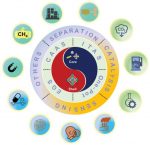
Encapsulation of active guest compounds inside metal–organic frameworks (MOFs) architectures is one of the most promising routes to reach properties beyond those of the bare MOFs and/or guest species. In contrast with the conventional host/guest composites that rely on the encapsulation of guest species into MOF cavities, core–shell composites display a better accessibility to the pores ensuring an optimal diffusion of the substrate while presenting a unique structure that prevents the aggregation and the runoff of the active guests and ensures a tight interaction between core and shell, leading to synergistic effects. Herein, the recent advances in this field are summarized. The main synthetic strategies are first discussed before highlighting a few potential applications, such as heterogeneous environmental catalysis, gas separation, and sensing, while others (bio‐applications…) are briefly mentioned. This review is concluded by a critical perspective in order to promote new generations of MOFs based composites for energy‐related applications.

IMAP is glad to be part of the MOF4AIR project, check our project video!

video here

Decades of combustion of fossil fuels and CO2 emissions have made climate change one of the most serious challenges that humanity has to face today. The development of a strong CCUS chain (for Carbon Capture, Utilisation and Storage) is a solution to capture carbon dioxide before it is even emitted into the atmosphere and therefore minimize human greenhouse gas (GHG) emissions.

The MOF4AIR project:
The MOF4AIR project is a project financed by the European Commission to develop and demonstrate a new solution to capture more efficiently carbon dioxide from power plants and industries. To do so, MOF4AIR uses carbon dioxide adsorption with innovative porous sorbents called Metal-organic frameworks (MOFs) that have shown promising potential for selective removal of carbon dioxide from exhaust gases. However, MOFs have so far not been properly tested in the harsh industrial conditions present in real exhaust gases and at the exposure times needed to be used in real CO2 capture processes. The purpose of the MOF4AIR project is thus to test the performances of MOFs in real industrial operation in order to support the progress of carbon capture and the decarbonization of the industry and power supply through CCUS.

This video presents the MOF4AIR project.

More information
Useful links:
– Visit our Website: https://www.mof4air.eu/

– Follow us on LinkedIn: https://www.linkedin.com/company/mof4…

– Follow us on Twitter: https://twitter.com/mof4air

– Contact us: contact@mof4air.eu

Project duration: July 2019 – July 2023
Partners: University of MONS, SINTEF, Centre National De La Recherche Scientifique (CNRS), Politecnico di Milano, Centre for Renewable Energy Sources And Saving Foundation, SiKEMIA, MOF Technologies Limited, Korea Research Institute of Chemical Technology (KRICT), ENG TECH Co., Technology Centre Mongstad, SOLAMAT MEREX, Türkiye Petrol Rafinerileri A.Ş. (Tüpraş), Euroquality, Türkiye Çimento Müstahsilleri Birliği.