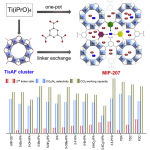
The complexity of Ti chemistry in solution not only leads to the difficulty of isolating crystalline titanium metal-organic frameworks (Ti-MOFs) but also brings the challenge of controlled assembly of the crystal structure. We report here the first example of a controlled synthesis of a Ti-MOF structure through a linker-exchange strategy directly from a preformed Ti-O cluster. A Ti8O8 cluster precursor with terminal formate and acetate ligands (Ti8AF) was reacted with tri- mesic acid (BTC) under green and mild conditions, generating a microporous Ti-MOF (MIP-207) while preserving the connection and configuration of the Ti8O8 core. In addition, due to the ditopic meta-positional connection mode of the linker, the chemical environment and functionality of the structural voids could be easily tuned by substituting trimesate moieties with isophthalate-type linkers via concise one-pot reactions. This finally resulted in an adjustable per- formance in CO2 capture over N2.

References:
Toward a Rational Design of Titanium Metal-Organic Frameworks
Sujing Wang, Helge Reinsch, Nicolas Heymans, Mohammad Wahiduzzaman, Charlotte Martineau-Corcos, Guy De Weireld, Guillaume Maurin, and Christian Serre
Matter 2, 1–11, 2020
DOI: 10.1016/j.matt.2019.11.002
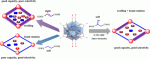
Engineering the structural flexibility of metal–organic framework (MOF) materials for separation-related applications remains a great challenge. We present here a strategy of mixing rigid and soft linkers in a MOF structure to achieve tunable structural flexibility, as exemplified in a series of stable isostructural Zr-MOFs built with natural C4 linkers (fumaric acid, succinic acid, and malic acid). As shown by the differences in linker bond stretching and bending freedom, these MOFs display distinct responsive dynamics to external stimuli, namely, changes in temperature or guest molecule type. Comprehensive in situ characterizations reveal a clear correlation between linker character and MOF dynamic behavior, which leads to the discovery of a multivariate flexible MOF. It shows an optimal combination of both good working capacity and significantly enhanced selectivity for CO2/N2 separation. In principle, it provides a new avenue for potentially improving the ability of microporous MOFs to separate other gaseous and liquid mixtures.

References:
Engineering Structural Dynamics of Zirconium Metal–Organic Frameworks Based on Natural C4 Linkers
Sujing Wang, Nertil Xhaferaj, Mohammad Wahiduzzaman, Kolade Oyekan, Xiao Li, Kevin Wei, Bin Zheng, Antoine Tissot, Jérôme Marrot, William Shepard, Charlotte Martineau-Corcos, Yaroslav Filinchuk, Kui Tan, Guillaume Maurin, Christian Serre
J. Am. Chem. Soc. 2019, 141, 43, 17207-17216
DOI: 10.1021/jacs.9b07816
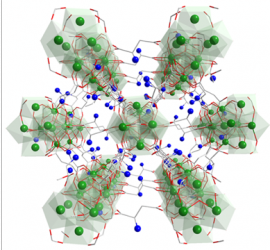
Proton conductive materials are of significant importance and highly desired for clean energy-related applications. Discovery of practical metal-organic frameworks (MOFs) with high proton conduction remains a challenge due to the use of toxic chemicals, inconvenient ligand preparation and complication of production at scale for the state-of-the-art candidates. Herein, we report a zirconium-MOF, MIP-202(Zr), constructed from natural α-amino acid showing a high and steady proton conductivity of 0.011 S cm−1 at 363 K and under 95% relative humidity. This MOF features a cost-effective, green and scalable preparation with a very high space-time yield above 7000 kg m−3 day−1. It exhibits a good chemical stability under various conditions, including solutions of wide pH range and boiling water. Finally, a comprehensive molecular simulation was carried out to shed light on the proton conduction mechanism. All together these features make MIP-202(Zr) one of the most promising candidates to approach the commercial benchmark Nafion.

Pour plus d’informations, consultez notre communiqué de presse : Produire de l’énergie « verte » avec un matériau hybride à base d’acide aminé naturel !
References:
A Robust Zirconium Amino Acid Metal-Organic Framework for Proton Conduction
Sujing Wang, Mohammad Wahiduzzaman, Louisa Davis, Antoine Tissot, William Shepard, Jérôme Marrot, Charlotte Martineau-Corcos, Djemel Hamdane, Guillaume Maurin, Sabine Devautour-Vinot and Christian Serre
Nature Communications volume 9, Article number: 4937 (2018)
DOI: 10.1038/s41467-018-07414-4
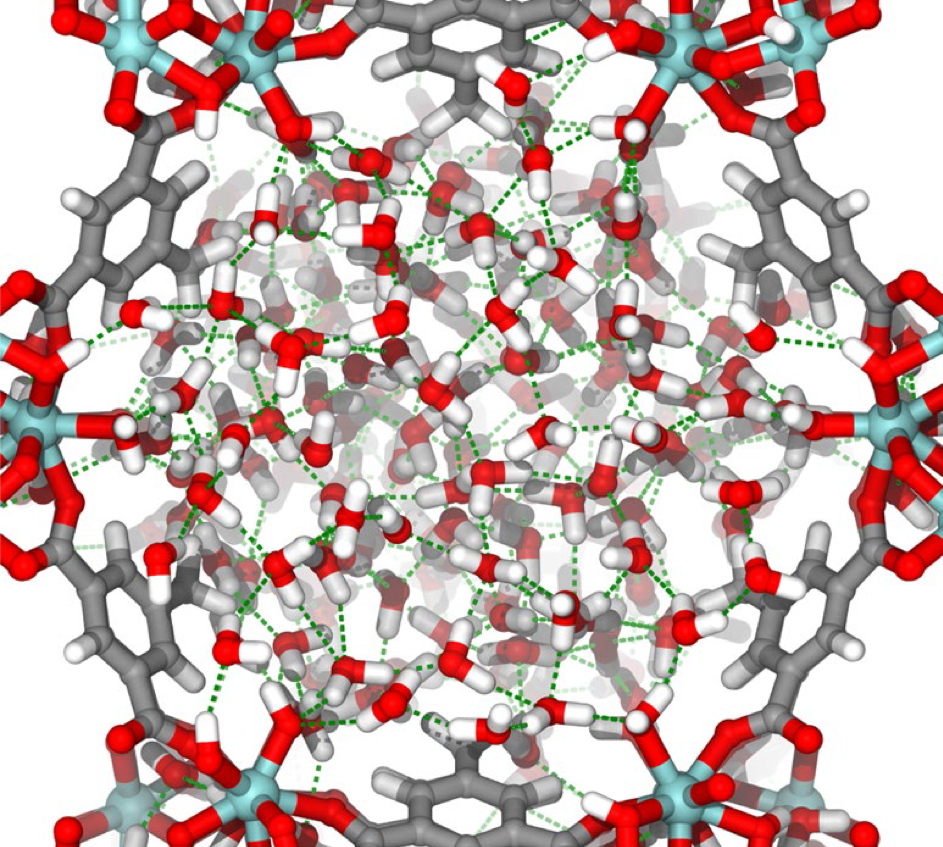
The discovery of more-efficient and stable water adsorbents for adsorption-driven chillers for cooling applications remains a challenge due to the low working capacity of water sorption, high regeneration temperature, low energy efficiency under given operating conditions and the toxicity risk of harmful working fluids for the state-of-the-art sorbents. Here we report the water-sorption properties of a porous zirconium carboxylate metal–organic framework, MIP-200, which features S-shaped sorption isotherms, a high water uptake of 0.39 g g−1below P/P0 = 0.25, facile regeneration and stable cycling, and most importantly a notably high coefficient of performance of 0.78 for refrigeration at a low driving temperature (below 70 °C). A joint computational–experimental approach supports that MIP-200 may be a practical alternative to the current commercially available adsorbents for refrigeration when its water adsorption performance is combined with advantages such as the exceptional chemical and mechanical stability and the scalable synthesis that involves simple, cheap and green chemicals.

Consultez le communiqué de presse associé à cet article : Un solide nanoporeux pour une réfrigération plus efficace
References :
A Robust Energy-Efficient Metal-Organic Framework Adsorbent for Refrigeration
Sujing Wang, Ji Sun Lee, Mohammad Wahiduzzaman, Jaedeuk Park, Mégane Muschi, Charlotte Martineau-Corcos, Antoine Tissot, Kyung Ho Cho, Jérôme Marrot, William Shepard, Guillaume Maurin*, Jong-San Chang*, and Christian Serre*
Nature Energy 2018
DOI: 10.1038/s41560-018-0261-6

3rd International Conference on Metal Organic Frameworks and Porous Polymers
October 27th – October 30th 2019 – Paris, France
More information: https://euromof2019.sciencesconf.org/

Based on the success of the two previous EuroMOF conferences organized in Postdam (2015) and Delft (2017), more than 450 researchers in the field of MOFs, COFs and porous polymers from all over the world are expected to join us for a new edition of the EuroMOFs 2019 conference. The conference will be held in Paris (France) the 27th-30th of October 2019.
Internationally renown speakers have already accepted to give a Plenary or Keynote lecture which will certainly make this event a great success.
A young investigator symposium will be organized before the EuroMOFs conference while an industrial workshop will be held right after the conference.
Chairs : Dr. Christian Serre and Prof. Guillaume Maurin.
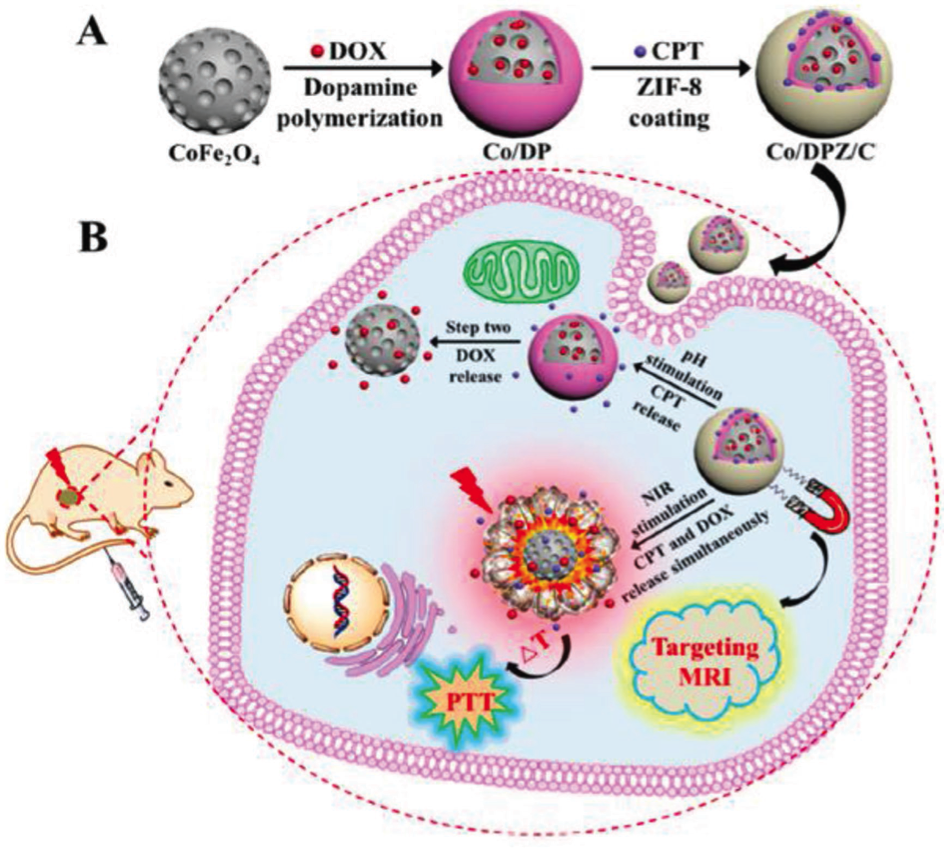
In the past few years, numerous studies have demonstrated the great potential of nano particles of metal-organic frameworks (nanoMOFs) at the preclinical level for biomedical applications. Many of them were reported very recently based on their bioactive composition, anticancer application, or from a general drug delivery/theranostic perspective. In this review, the authors aim at providing a global view of the studies that evaluated MOFs’ biomedical applications at the preclinical stage, when in vivo tests are described either for pharmacological applications or for toxicity evaluation. The authors first describe the current surface engineering approaches that are crucial to understand the in vivo behavior of the nanoMOFs. Finally, after a detailed and comprehensive analysis of the in vivo studies reported with MOFs so far, and considering the general evolution of the drug delivery science, the authors suggest new directions for future research in the use of nanoMOFs for biomedical applications.

References:
Nanoparticles of Metal-Organic Frameworks: On the Road to In Vivo Efficacy in Biomedicine
Teresa Simon-Yarza, Angelika Mielcarek, Patrick Couvreur & Christian Serre
Adv. Mater. 2018, 1707365
DOI: 10.1002/adma.201707365
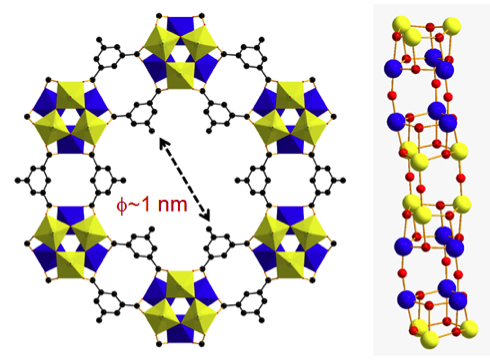
Porous titanium oxide materials are attractive for energy-related applications. However, many suffer from poor stability and crystallinity. Here we present a robust nanoporous metal–organic framework (MOF), comprising a Ti12O15 oxocluster and a tetracarboxylate ligand, achieved through a scalable synthesis. This material undergoes an unusual irreversible thermally induced phase transformation that generates a highly crystalline porous product with an infinite inorganic moiety of a very high condensation degree. Preliminary photophysical experiments indicate that the product after phase transformation exhibits photoconductive behavior, highlighting the impact of inorganic unit dimensionality on the alteration of physical properties. Introduction of a conductive polymer into its pores leads to a significant increase of the charge separation lifetime under irradiation. Additionally, the inorganic unit of this Ti-MOF can be easily modified via doping with other metal elements. The combined advantages of this compound make it a promising functional scaffold for practical applications.

Pour plus d’informations, consultez le commniqué de presse associé à cet article :
À la recherche d’un oxyde de titane poreux !
References:
A phase transformable ultrastable titanium-carboxylate framework for photoconduction
Sujing Wang, Takashi Kitao, Nathalie Guillou, Mohammad Wahiduzzaman, Charlotte Martineau-Corcos, Farid Nouar, Antoine Tissot, Laurent Binet, Naseem Ramsahye, Sabine Devautour-Vinot, Susumu Kitagawa, Shu Seki, Yusuke Tsutsui, Valérie Briois, Nathalie Steunou, Guillaume Maurin, Takashi Uemura and Christian Serre
Nature Communications, 9, 1660 (2018)
DOI: 10.1038/s41467-018-04034-w
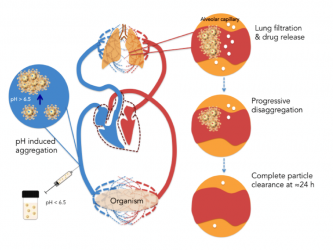
Despite high morbidity and mortality associated to lung diseases, addressing drugs towards lung tissue remains a pending task. Particle lung filtration has been proposed for passive lung targeting and drug delivery. However, toxic issues, derived from the long-term presence of the particles must be overcome. We show here that by exploiting some of the ignored properties of nanosized metal-organic frameworks it is possible to achieve impressive antitumoral effects on experimental lung tumours, even without the need to engineer the surface of the material. In fact, it was discovered that, based on unique pH-responsiveness and reversible aggregation behaviors, nanoMOF was capable to target the lung tissue. At the neutral pH of the blood, the nanoMOFs form aggregates with the adequate size to be retained within the lung capillaries. Then, within 24 h they disaggregate and release their drug payload. This phenomenon was compatible with lung tissue physiology.

References:
Smart Metal-Organic-Framework Nanomaterial for Lung Targeting
Simon-Yarza T, Giménez-Marqués M, Mrimi R, Mielcarek A, Gref R, Horcajada P, Serre C, Couvreur P
Angew Chem Int Ed. 2017 Sep 28.
doi: 10.1002/anie.201707346
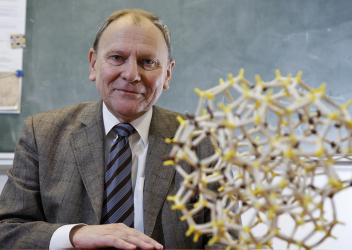
Gérard Férey (1941-2017)

C’est avec une grande tristesse que nous avons appris le décès du professeur Gérard Férey, l’un des pionniers des solides poreux cristallisés, en particulier ceux de type MOFs ou Metal-Organic Frameworks.
Gérard est né en Normandie en 1941 et a connu plusieurs vies scientifiques. Tout d’abord à l’université du Mans à partir des années 60 ou après quelques succès sur l’étude de fluorures métalliques magnétiques, il s’est investi dans le monde des fluorophosphates métalliques microporeux; on peut noter à ce stade le soin particulier de Gérard pour l’étude des mécanismes de formation de ces solides ainsi que leur genèse de manière contrôlée le tout avec l’appui de la modélisation numérique. En 1996, il quitte l’université du Mans pour créer l’Institut Lavoisier de Versailles au sein de l’université de Versailles St Quentin en Yvelines. C’est à ce moment que débute son aventure fascinante dans le monde des solides hybrides inorganiques-organiques de type MOFs ou pendant près de 15 ans il en fut l’un des leaders incontestés sur le plan international. Cela a conduit à plusieurs succès retentissants avec la découverte de séries de MOFs de référence dans le domaine. On citera tout particulièrement les solides à flexibilité géante MIL-53 et MIL-88 (MIL pour Matériaux de L’Institut Lavoisier) ou les solides à pores géants de type MIL-100 et MIL-101.
Gérard a reçu de nombreuses récompenses pendant sa carrière telles que la médaille d’Or du CNRS, le prix ENI de l’environnement, le prix Von Humboldt, parmi tant d’autres. Gérard était membre de l’académie des Sciences et a toujours été un ardent défenseur de la chimie.
L’héritage laissé par le professeur Férey est immense en témoigne l’activité toujours très intense de la communauté MOFs autour des fameux matériaux poreux de type MIL-n, en particulier au sein de l’Institut des Matériaux Poreux de Paris du département chimie de l’ENS, dirigé par Christian Serre, dont Gérard Férey a été le mentor. Les enjeux restant à relever se situent principalement autour de la découverte de MOFs à stabilité renforcée (chimique) mais aussi de leur intégration dans des procédés ou dispositifs applicatifs.
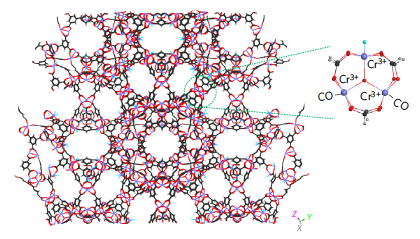
Selective dinitrogen binding to transition metal ions mainly covers two strategic domains: biological nitrogen fixation catalysed by metalloenzyme nitrogenases, and adsorptive purification of natural gas and air. Many transition metal–dinitrogen complexes have been envisaged for biomimetic nitrogen fixation to produce ammonia. Inspired by this concept, herewe report mesoporous metal–organic framework materials containing accessible Cr(III) sites, able to thermodynamically capture N2 over CH4 and O2. This fundamental study integrating advanced experimental and computational tools confirmed that the separation mechanism for both N2/CH4 and N2/O2 gas mixtures is driven by the presence of these unsaturated Cr(III) sites that allows a much stronger binding of N2 over the two other gases. Besides the potential breakthrough in adsorption-based technologies, this proof of concept could open newhorizons to address several challenges in chemistry, including the design of heterogeneous biomimetic catalysts through nitrogen

N’hésitez pas à consulter le communiqué de presse associé à cet article :
Purifier le gaz naturel ou l’air avec un matériau nanoporeux !
References:
Selective nitrogen capture by porous hybrid materials containing accessible transition metal ion sites
JiWoong Yoon, Hyunju Chang, Seung-Joon Lee, Young Kyu Hwang, Do-Young Hong, Su-Kyung Lee, Ji Sun Lee, Seunghun Jang, Tae-Ung Yoon, Kijeong Kwac, Yousung Jung, Renjith S. Pillai, Florian Faucher, Alexandre Vimont, Marco Daturi, Gérard Férey, Christian Serre, Guillaume Maurin, Youn-Sang Bae and Jong-San Chang
Nature Materials, 19 décembre 2016
doi : 10.1038/nmat4825