
Check out IMAP new article entitled:
Photoaccumulation of Long-Lived Reactive Electrons in a Microporous Ti(IV) Oxocluster-Based Metal–Organic Framework for Light and Dark Photocatalysis
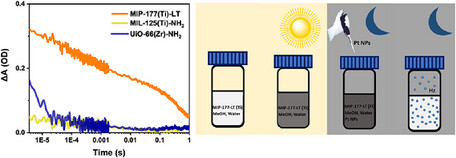
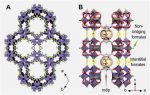
The microporous Ti12 oxocluster-based metal–organic framework (MOF) MIP-177(Ti)-LT exhibits excellent stability and photoactivity, making it highly promising for photocatalysis. Using transient and photoinduced absorption spectroscopies, the behavior of reactive electrons in MIP-177(Ti)-LT across femtosecond-to-second timescales is investigated. The framework shows efficient charge separation and slow decay kinetics, with photogenerated charges persisting into the microsecond-second (µs-s) range and displaying higher yields and slower recombination than benchmark MOFs MIL-125(Ti)-NH2 and UiO-66(Zr)-NH2. Photogenerated holes oxidize water with an O2 yield of 335 µmol g−1 h−1 in the presence of electron scavengers. Under continuous irradiation, long-lived electrons accumulate, further enhanced by a hole scavenger (methanol). Remarkably, these electrons persist over 48 h post-excitation under argon, accompanied by a reversible white-to-black color change. The stored electrons remain redox-active, efficiently reducing added O2 and methyl viologen. Dark addition of a Pt co-catalyst to photocharged MIP-177(Ti)-LT induces H2 evolution at ≈300 µmol g−1 (≈58 C g−1), corresponding to an accumulated electron density of one electron per 12 Ti atoms. These results highlight the photocharging properties of MIP-177(Ti)-LT and its potential for sustainable photocatalytic applications.
More info here: https://advanced.onlinelibrary.wiley.com/doi/10.1002/adma.202517595